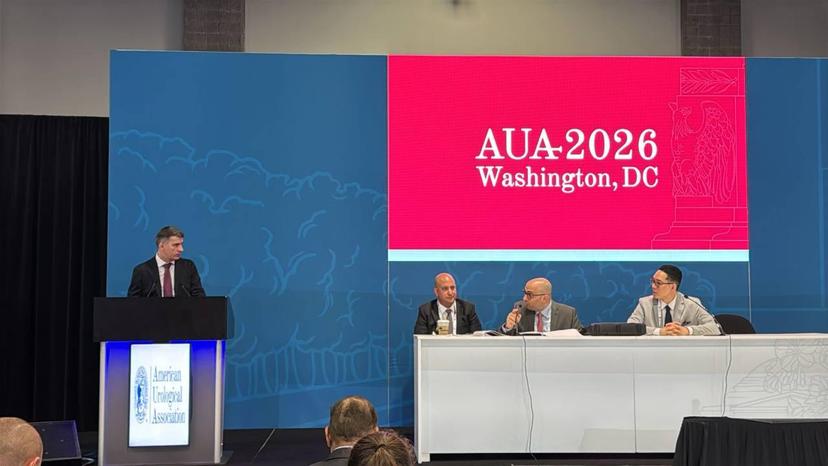
VPG LaserOne technologies were featured at the American Urological Association Annual Meeting (AUA 2026) in Washington, D.C., the world's largest scientific congress dedicated to urology. Clinical studies presented by leading international experts demonstrated the expanding role of thulium fiber laser (TFL) technology in the management of urinary stone disease, benign prostatic hyperplasia (BPH), and AI-assisted surgical guidance, highlighting continued progress in minimally invasive urological surgery.
Award-winning clinical research
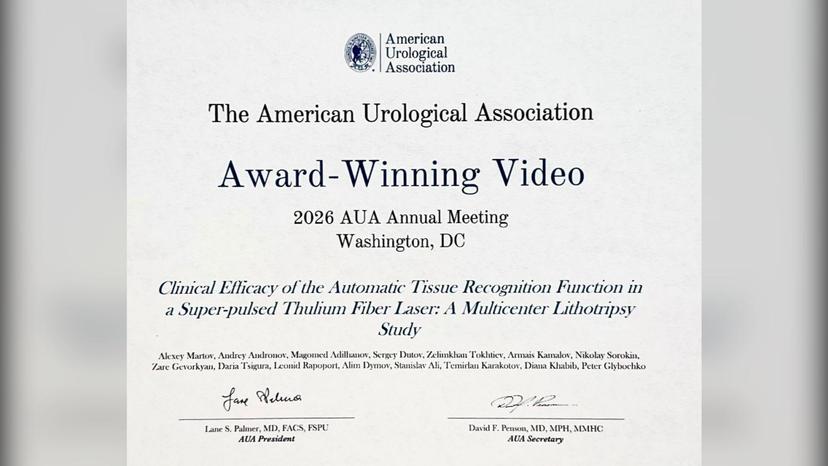
One of the congress highlights was the presentation "Clinical Efficacy of the Automatic Tissue Recognition Function in a Super-Pulsed Thulium Fiber Laser: A Multicenter Lithotripsy Study," which received the prestigious AUA Award-Winning Video distinction.
The multicenter study demonstrated the clinical value of VPG LaserOne's Tissue Sensor technology, which automatically recognizes soft tissue during lithotripsy and temporarily interrupts laser emission to support safer stone treatment and help reduce the risk of unintended tissue injury.
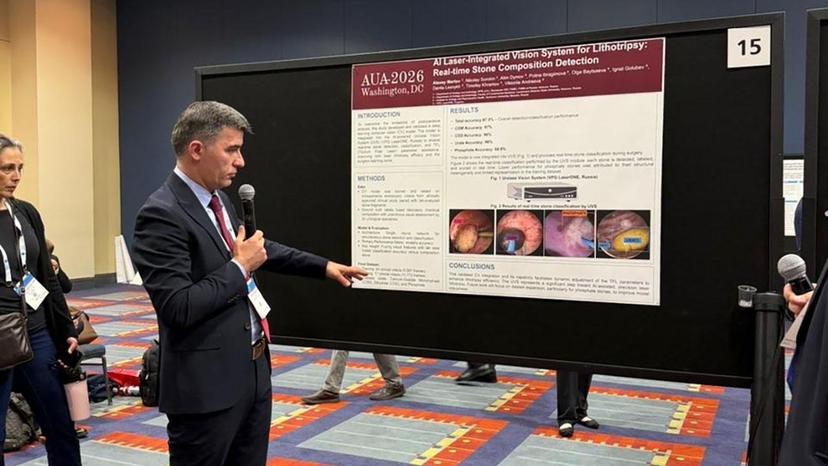
Prof. Alim Dymov, MD, Dr.Sc. (Med.), presented a series of clinical studies at AUA 2026 demonstrating the latest advances in VPG LaserOne's thulium fiber laser technologies for lithotripsy and BPH treatment.
Advancing thulium fiber laser applications
The scientific program featured several presentations showcasing new clinical applications of thulium fiber laser technology.
In the field of urolithiasis, researchers presented studies on:
- automatic tissue recognition during laser lithotripsy using Tissue Sensor;
- temperature control during lithotripsy through the evaluation of a novel thermochromic laser fiber;
- AI-integrated laser vision technology for real-time stone composition detection and intraoperative treatment optimization.
These studies highlighted the growing integration of intelligent technologies with laser surgery to improve precision, workflow efficiency, and clinical decision-making.
Expanding opportunities for BPH treatment
Scientific sessions also explored the evolving role of TFL in the treatment of benign prostatic hyperplasia (BPH).
Presentations included:
- the MILES trial: a prospective randomized study comparing the safety and efficacy of minimally invasive versus standard laser enucleation;
- retrospective analysis of Minimally Invasive Laser Enucleation of the Prostate (MiLEP) using TFL with slim and ultra-slim resectoscopes;
- ejaculation-preserving thulium fiber laser enucleation for BPH, demonstrating an approach aimed at preserving postoperative ejaculatory function.
Together, these studies demonstrated the continued expansion of thulium fiber laser technology beyond lithotripsy into advanced soft-tissue surgery.
Driving the future of intelligent endourology
Beyond the scientific presentations, AUA 2026 provided an important platform for discussing the future of intelligent laser surgery. Researchers and clinicians shared experience with technologies that combine advanced laser physics, automated tissue recognition, and artificial intelligence to support safer, more precise, and more personalized treatment.
The strong scientific presence of studies involving VPG LaserOne technologies at AUA 2026 reflects the company's commitment to advancing evidence-based innovation through close collaboration with leading clinical experts. As intelligent laser systems continue to evolve, VPG LaserOne remains focused on developing solutions that improve surgical precision, procedural safety, and patient outcomes in modern urology.